
 Port access
- The EES will streamline border controls, enhance security and modernise the service provided to passengers on both ferries and cruise ships.
- The Port Authority, the National Police and Brittany Ferries have worked together to introduce the system.
- Investment by the Port Authority in the new system stands at over 6.4 million euros, part-funded by the European Union.
Border controls at the Port of Bilbao are now faster, more efficient and more secure, following the introduction of the new digital border control system for travellers from non-EU countries, with the exception of Cyprus and Ireland, or who are not nationals of Iceland, Liechtenstein, Norway or Switzerland. The Port Authority and the National Police have worked together on rolling out the system, as has Brittany Ferries, the shipping company that operates the ferries calling at the port.
The Entry/Exit System (EES) automates the requirements for entry border control within the Schengen Area through a digital register maintained by the European Union. These requirements are set out in Article 6 of the Schengen Borders Code, Article 25 of the Spanish Immigration Law and Articles 4 et seq. of the Immigration Regulations. One of these requirements is to be in possession of a valid travel document and to have it stamped.
The new EES replaces the manual stamping of passports with a digital record that includes biographical data, the date and place of crossing, and biometric data (facial image and fingerprints). The aim is to modernise the management of external borders, improve the detection of overstayers and strengthen internal security.
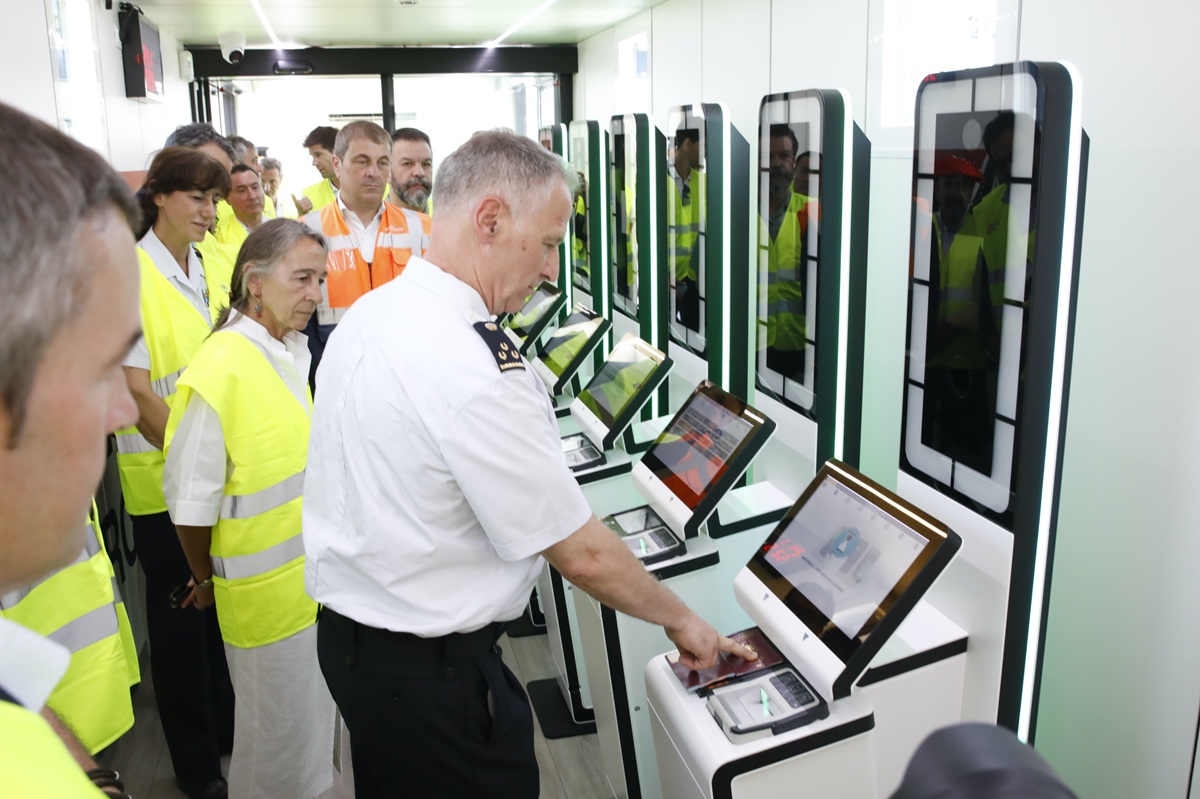
This automated system, which became mandatory in the EU this year, has been introduced at both the Getxo cruise terminal and the Zierbena ferry terminal. After several months of work, the Port of Bilbao is now able to ensure a smooth transition that complies with the new regulations. To this end, self-service solutions and a vehicle flow guidance system tailored to the needs of Ro-Pax services have been put into operation, enabling the authorities to work more efficiently.
Where necessary, the EES helps to track people entering and leaving the Schengen area, using fingerprint and facial data to prevent people from overstaying their authorised period of stay, using false identities, misusing visa-free travel or posing security risks.
The presentation to the port community was attended by Marisol Garmendia, Government Delegate for the Basque Country, and Ivan Jimenez, president of the Bilbao Port Authority. Ms Garmendia pointed out that “the introduction of the Entry/Exit System is not simply a case of new technology uptake; it is the realisation of a European policy committed to strengthening security, improving border management and, at the same time, providing a more reliable and convenient service for travellers. The Port of Bilbao plays a strategic role as a gateway for thousands of people travelling in and out each year. It was therefore essential for this infrastructure to be ready to meet this challenge head-on both safely and effectively.”
“Once again”, she added, “collaboration between public authorities has been the key to success. When institutions work together in a coordinated manner, complex projects can be taken forward successfully to the benefit of all citizens. She then concluded by saying that “this project is also a reflection of the Spanish Government’s firm commitment to the digital transformation of public services and to meeting its European commitments. The significant investment made, with financial support from the European Union, will provide modern facilities equipped to meet the present and future needs of border control.”
For his part, Mr Jimenez explained that “the introduction of the EES has been an operational challenge and has been made possible thanks to close cooperation with the National Police. At the same time, it has enabled us to modernise our processes by digitising them, whilst ensuring that the flow of incoming tourists remains smooth so that neither disembarkation nor subsequent embarkation is delayed”. Jimenez also took the opportunity to thank “the Port Authority team and the National Police for their tremendous effort and hard work, as well as all the other organisations and individuals involved in bringing this project to a successful conclusion, which will help to improve passenger safety and comfort”.
EU funding
The investment made for the introduction and subsequent maintenance of the EES, in terms of both equipment and staff, has exceeded 6,4 million euros, and will be subsidised by the EU.
A grant has been received for equipment from the Financial Support Instrument for Border Management and Visa Policy (BMVI), which covers equipping all relevant areas with self-service kiosks for the biometric registration of third-country passengers; National Police control booths and posts, including furnishings, structured cabling and associated civil engineering works; verification and monitoring tablets, CCTV surveillance systems for the equipment and network electronics; biometric capture devices (fingerprint readers, facial recognition cameras and document readers) and their integration with national and European central systems; passenger flow management elements and associated signage; and installation, configuration, commissioning and training services.
Furthermore, the BMVI has awarded a grant to cover the maintenance of equipment and associated staff costs, earmarked for the preventive and corrective maintenance of biometric kiosks, control booths, biometric capture devices (fingerprint readers, facial recognition cameras and document readers), verification tablets, associated CCTV systems and network electronics; technical support services, software updates and ensuring system availability throughout the eligibility period; and staff costs directly associated with border control operations.