
 Port access
The Port of Bilbao closed the 2025 financial year with a throughput of just over 32 million tonnes, down 2.3 million (6.8%) on the previous year’s figures and attributable to some extent to the technical shutdown of the Petronor plant between May and July. At the same time, however, it is worth noting that throughput in the second half of the year was up 1.5% compared to the previous year. The Port Authority considers that the traffic figures do not detract from a key year for improving the competitiveness of the main port in the Atlantic Arc, with progress made on key projects in areas such as connectivity, decarbonisation, infrastructure and digitalisation that will shape the immediate future of the Port. The first results of these projects will be seen in 2026.
In terms of traffic, the year was affected, on the one hand, by a two-month scheduled technical shutdown at the Petronor refinery. Without this shutdown, the purpose of which was to improve safety and incorporate innovations to improve efficiency and reduce emission levels, traffic would have fallen by 0.5%, in line with the 0.2% decline in the state port system. This trend was even more pronounced in practically all eight major ports, e.g. Algeciras -3.3%, Barcelona -0.4%, Valencia -0.7%, with the exception of Las Palmas, which, due to its geographical location, has benefitted from the consequences of the application of the Emissions Trading System (ETS).
Geopolitical tensions have also had a significant impact on foreign trade, causing exports to fall by 13% and imports by nearly 4%, particularly in the case of liquid bulk imports/exports and container exports. Leaving aside the effect of the technical shutdown at Petronor and the strike, exports fell by 8.3%, while imports increased by 3.2%.
In absolute terms, figures show a marked decline in three hydrocarbons: crude oil, down 13% or 1.3 million tonnes less imported; gasoil (557,150 tonnes less than in 2024); and petrol (down 121,208 tonnes). The greatest growth by volume was seen in natural gas imports, which stood at 3.6 million tonnes, up 5% or 167,064 tonnes, followed by feed and fodder, especially imports (+99,308 tonnes), non-metallic minerals (+61,770), scrap iron (+40,189), building materials (+26,120) and preserves (+19,939).
Markets and improvements in connectivity
In terms of exports, the United Kingdom continues to lead the ranking, with the Port of Bilbao remaining the main entry and exit point for Spanish traffic with this country, while the United States ranks first in terms of imports.
In fact, the market with the highest growth is the United States (up 1.3 million tonnes, reaching nearly 4.7 million), with a total increase in goods of 40% but with a significant increase in imports (62%), mainly due to an 85% increase in liquid bulk and, more specifically, a 228% increase in gas imports. The United States has thus become the leading market of origin for natural gas, rising from 15% of total gas traffic in 2024 to 49% in 2025 and overtaking Russia, whose share stands at 48% compared to 77% in 2024. However, exports to the United States are down 38%, with a notable decline in chemical products (43%) and machine tools (16%).
Other countries showing a positive growth trend include Brazil, Senegal, the Netherlands, China, Uruguay, Gabon and Indonesia.
These figures once again confirm that Bilbao is a port for both short and deep sea shipping. In fact, new and important opportunities are opening up in the American market with the launch in December of two direct container services by the shipping company MSC: one to Canada and the other to the west coast of South America, calling at ports in the Dominican Republic, Colombia, Panama, Peru and Chile. In January alone, traffic with these two areas increased by nearly 120,000 tonnes compared to January last year.
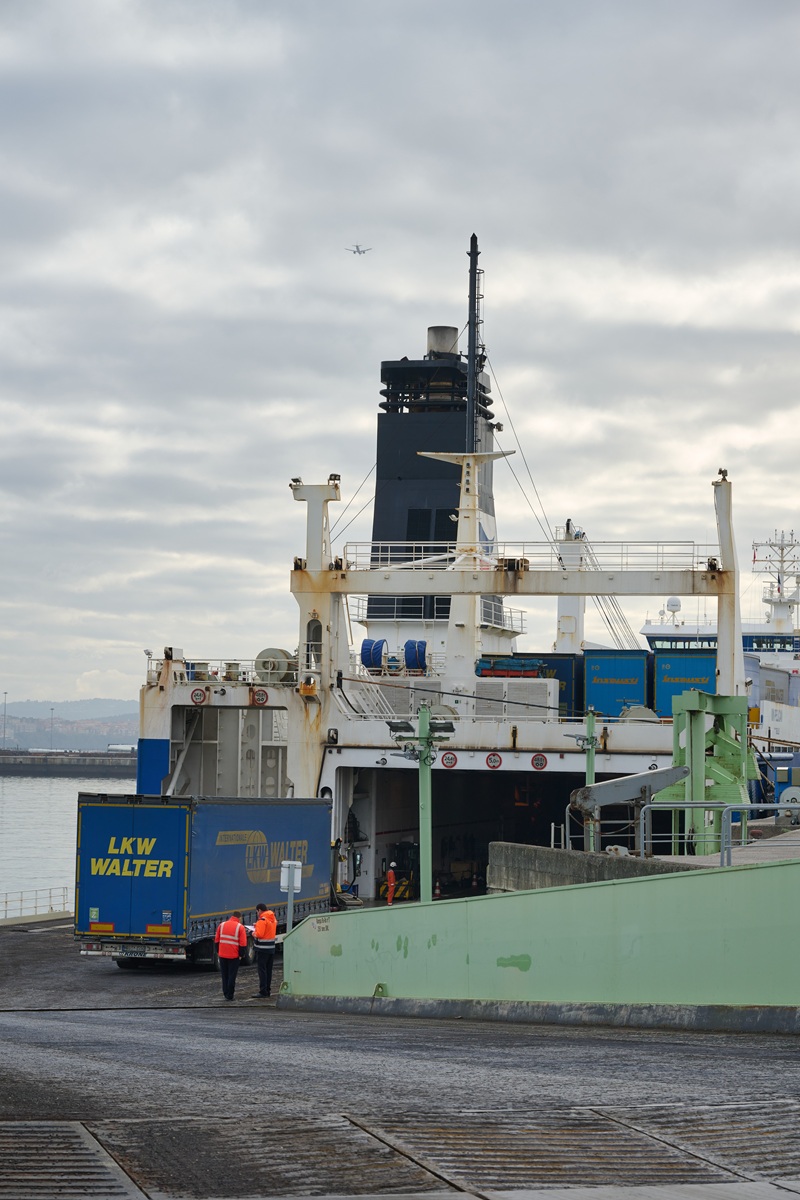
Added to this are new connections with Europe, such as that of the shipping company Finnlines, a subsidiary of the Grimaldi Group, which has added a stopover in the Polish port of Gdynia, and WEC Lines, which has updated its containerised freight service with the United Kingdom and Ireland with the addition of a second vessel, allowing for new stopovers and a faster route. All of this opens up new possibilities for attracting freight that is currently transported by road.
In terms of connectivity, the Bilbao Port Authority welcomes the start of works on the Southern Rail Bypass, a long-awaited and key project for the logistics and port community in Bilbao, which is committed to rail transport. In 2025, a total of 3,800 trains entered and left the port, an average figure of almost 10.5 trains per day. The share of containers transported by rail remains at 26%, and Bilbao continues to be the leader in this respect in the port system.
In short, these initiatives and results, combined with the commitment of the Port of Bilbao to intermodal transport and existing short-distance lines, contribute to improving the competitiveness of the port, and make it a key player in the decarbonisation of transport within the logistics chain.
Vessels and passengers
The number of vessels passing through the port in 2025 stood at 2,611, an average of seven vessels per day.
In terms of passenger traffic, the Port of Bilbao set a new record for the fourth consecutive year, with 337,562 passengers arriving or departing, a 20% increase on the previous year. Cruise passengers accounted for 54% of this figure, while 46% were passengers on ferries connecting with the United Kingdom and Ireland. The number of cruise ships and ferries calling at the port stood at 95 and 162, respectively.