
 Port access
Ivan Jimenez, president of the Bilbao Port Authority, has taken part in an international exchange and discussion session on “City-Port” initiatives in Québec City, Canada, organised as part of the Atlantic Arc Commission General Assembly of the Conference of Peripheral Maritime Regions (CPMR).
The event brought together institutional representatives, port authorities, Atlantic regions and international organisations to share experiences on the relationship between ports and their local regions, as well as on the challenges associated with the energy transition, sustainability, innovation and competitiveness.
As part of the discussion, Mr Jimenez outlined how the model followed by Bilbao, internationally recognised for the urban and regional transformation the city has undergone in recent decades, has developed over time, highlighting how collaboration between public administration, business and the community has made it possible to turn a period of profound industrial and port-related change into an opportunity for economic development and urban regeneration.
“The case of Bilbao has shown that processes of major transformation can only be taken forward successfully when there is a shared long-term vision and effective collaboration between institutions, business and local communities”, he noted, adding that, now that the urban transformation of Bilbao has been completed, the region itself faces a new set of challenges related to the decarbonisation of the economy, industrial competitiveness, innovation and resilience. Within this context, Mr Jimenez outlined some of the most important projects currently underway in the Port of Bilbao area, such as the electrification of the docks through the BilbOPS project, the roll-out of renewable energy, the development of alternative fuels, the production of renewable hydrogen, e-fuels, circular economy initiatives and projects linked to the green steel industry.
Mr Jimenez argued that ports are transitioning from their traditional role as logistics infrastructure to a broader role as platforms connecting industry, energy, innovation and the local region. “The major challenge is no longer simply about reducing emissions. The real challenge is coordinating multiple stakeholders to move forward together towards a sustainable transition that combines competitiveness, resilience and environmental sustainability”, he stated. He also highlighted the commitment of the Port of Bilbao to developing a Smart Energy Hub, integrating electrification, the production of renewable energy, energy storage, smart energy management and open innovation, as well as the role of BilbaoPortLab as a collaborative innovation platform to roll out real-world solutions in the port environment.
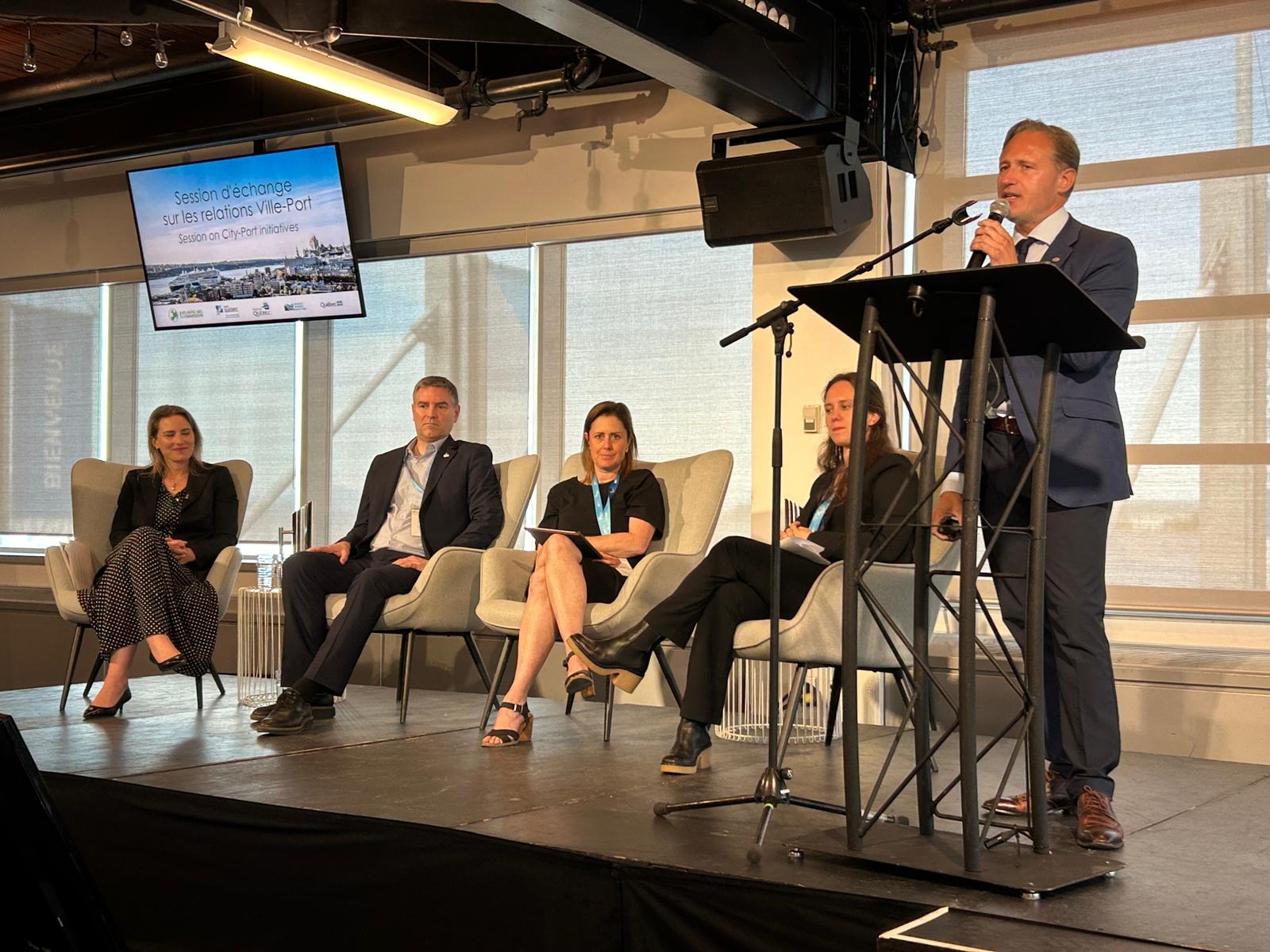
During the event, the president of the Bilbao Port Authority also spoke of new opportunities for collaboration between Québec and Bilbao in areas such as open innovation, experimental labs, industrial descarbonisation, digitalisation, green shipping corridors and Atlantic innovation ecosystems. “The next phase of transatlantic cooperation involves innovating together. Ports can become strategic platforms for connecting industry, energy, knowledge and innovation on both sides of the Atlantic,” he concluded.
The session was attended by representatives from the Port of Québec, the International Association of Cities and Ports (AIVP), the Green Alliance, the Port of Santander and the Nouvelle-Aquitaine Region, among other institutional and economic stakeholders linked to the Atlantic region.
About the Atlantic Arc Commission
The Atlantic Arc Commission, part of the Conference of Peripheral Maritime Regions (CPMR), brings together regions from Spain, France, Portugal, Ireland and other Atlantic territories to promote regional cooperation, economic competitiveness, sustainability and connectivity within the European Atlantic area.