
 Port access
- The Energy Transition Plan is progressing with the completion of the first phase of dock electrification, which will significantly reduce noise and CO2 emission levels of vessels calling at the port.
- The new European Union Entry and Exit System has been implemented
Planned investment for the 2026 financial year amounts to 87.1 million euros, 48% of which had already been spent as at 30 June. The Business Plan provides for a total planned investment for the period 2026–2030 of 308.8 million. The main actions carried out in the first half of the year are:
- Roll-out of the Energy Transition Plan
The Port Authority continues to roll out its Energy Transition Plan, a key element of which is the project to electrify the docks using an OPS (Onshore Power Supply) system. This will enable vessels to connect to the electricity grid and switch off their auxiliary engines whilst in port, significantly reducing noise and CO2 emission levels. The first phase of the project, which began at the end of 2023 and has been focused on Dock A5 of the central breakwater, was completed in May. Investment has totalled 4.5 million euros, with a grant of 3.9 million from the Recovery, Transformation and Resilience Plan – NextGenerationEU.
The second phase, awarded in April 2025 and due to be completed in 2027, is focused on Docks A1, A2, A6 and AZ3, and at the Getxo cruise ship terminals, to cater for container, ro-pax, ro-ro and cruise ship traffic. These works require an investment of 50.1 million euros and are part-funded by the European Commission through the CEF (Connecting Europe Facility) programme, the Recovery, Transformation and Resilience Plan – NextGenerationEU and the EIB (European Investment Bank). The OPS project will make the Port of Bilbao the first port on the Atlantic corridor to have all its docks electrified, ahead of EU requirements for 2030 and reaffirming the port’s commitment to sustainability and the energy transition. In the case of cruise ships, this could potentially mean a reduction in emissions of up to 95% whilst the vessels are berthed in the port.
Furthermore, to ensure that the energy consumed by connected vessels comes from renewable sources, the Port Authority is installing arrays of PV solar panels and is planning a future wind power project. The total investment in these projects, provided for within the Energy Transition Plan, will exceed 119 million euros.
At the same time, the Port Authority continues to implement measures to reduce CO2 emissions associated with its operations (fixed installations, electricity consumption, cooling and transport). These have been reduced by 72% over the last five years. In addition to this, between 2020 and 2025, air quality has remained within legal limits at all monitoring stations. PM10 particle levels, meanwhile, have been falling, reflecting a positive trend in air quality.
The Port of Bilbao has been and continues to be a benchmark for sustainability amongst European ports. For example, 15 February this year marked the twentieth anniversary of the inauguration of the port’s wind farm, consisting of five wind turbines, the first of its kind amongst all ports in Spain.
- Second phase of works on the central breakwater
Construction work on the second phase of the central breakwater, which began in the last quarter of 2024, is progressing at a good pace. With a budget of around 55 million, the project involves the creation of 1,011 metres of new berthing line spread across two new docks (A3 and A4), set to provide an additional port surface area of approximately 310,000 m².
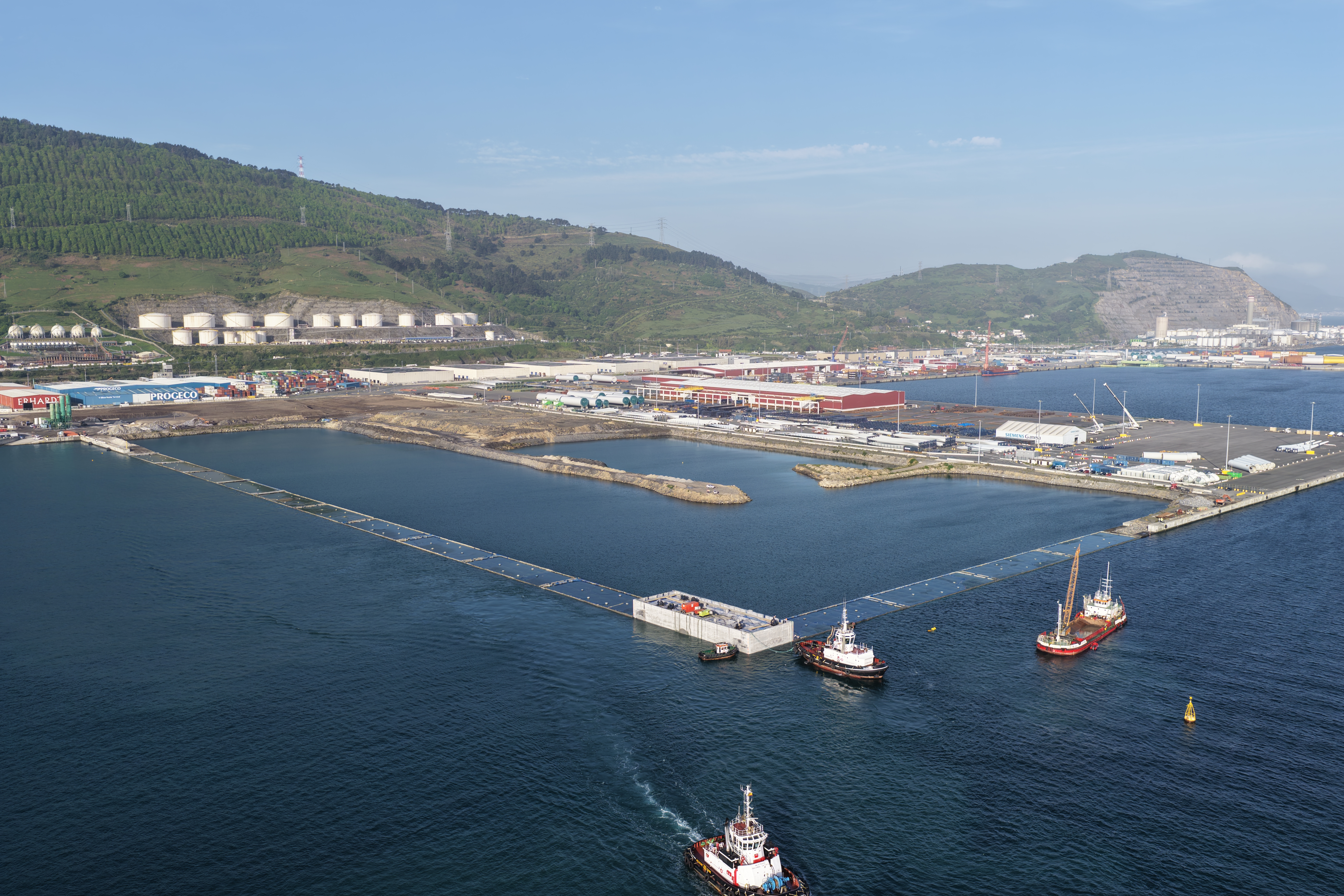
To do so, 15 reinforced concrete caissons have been built, anchored and backfilled, and work is currently underway on the rock-filled embankment behind the caissons. The first phase has commenced with the concreting of the rear beam, while the formwork traveller is being assembled in preparation for the forthcoming construction of the edge beam of the new berthing line.
- Roll-out of the EES
The Port Authority has deployed the EU Entry/Exit System (EES) at the ferry terminal in Zierbena and at the two cruise ship terminals in Getxo. The EES is a centralised European Union information system that electronically records every entry and exit of travellers from non-EU countries, replacing the manual passport stamp with a digital record. Investment has exceeded 7.1 million, of which 3.6 million is subsidised by the EU.
- New building for the Vessel Operations Department
Work is currently underway on the new building, at a cost of 1,079,384 euros, designed to house staff from the Vessel Operations Department. The building is due to be completed in spring 2027.
- Upgrades to refrigeration equipment
Bilbao is one of the ports authorised by the European Union to have a Border Control Post (BCP), where the Border Inspection Services conduct sanitary, phytosanitary, veterinary and quality inspections, with a view to ensuring that products from third countries, whether intended for human or non-human consumption, enter the EU market with the appropriate and necessary guarantees.
The Bilbao Container Terminal is at the forefront of Spanish ports. Between 2025 and May 2026, the Port Authority has invested 1,390,864 euros in improvements to the building, including the replacement of the refrigeration systems in the cold stores and at the loading bays, and new laboratories to house SOIVRE. The works were completed on 26 May, and investment this financial year exceeds 600,000 euros.