
 Port access
- The state-of-the-art Ship-to-Shore crane boosts the port’s capacity to handle large container ships and features energy-efficient systems that enable safer, more precise operations with a lower environmental impact.
- The 9.5 million euro investment forms part of CSP Spain’s investment plan in Bilbao, allocating more than 26 million euros over the last ten years as a sign of the company’s firm commitment to the Port of Bilbao.
CSP Iberian Bilbao Terminal, the concessionaire of the container terminal of the Port of Bilbao, continues to advance its strategic commitment to innovation and sustainability with the addition of a new state-of-the-art super post-Panamax (Ship-to-Shore, STS) crane. This equipment will substantially increase the terminal’s operational capacity, boosting its productivity and efficiency by incorporating the latest technology and features available for loading and unloading container ships in the Port of Bilbao.
The new acquisition is the largest quay crane in the Atlantic Arc and complements perfectly the other two super post-Panamax cranes already in operation at the terminal, representing a substantial step forward in operational capacity to better handle large vessels, reduce their turnaround time and thus strengthen the logistical competitiveness of companies in the hinterland of the Port of Bilbao. The new quay crane was purchased in October 2024 from the manufacturer ZPMC, a world leader in the manufacture of port cranes, and commissioned in early June 2026.
Cutting-edge technology for greater safety and efficiency
The new STS crane is equipped with state-of-the-art systems focused on safety and operational efficiency, such as anti-collision systems on the gantry and boom and cameras to assist with handling, which enable safer and more precise operations. Its design not only incorporates technological solutions focused on energy efficiency, helping to reduce environmental impact in line with CSP Spain’s sustainability objectives, but also features cutting-edge technology in automation, handling aids, operator stop assistance and an on-board camera system, enabling safe, optimal and precise load handling. Furthermore, the state-of-the-art crane cab not only represents a major ergonomic improvement for the operator but also substantially improves his/her visibility. In short, a qualitative leap forward in capacity and efficiency.
Other notable features include an outreach of 20 container widths, a total lifting height of 56 m, a twin-gantry handling capacity (2 full containers) of up to 65 tonnes and a hoisting capacity of up to 83 tonnes under wire rope, enabling the handling of general cargo and large components. The STS crane is also equipped with the most modern and efficient control and power systems, with energy recovery to the grid, which will help reduce the carbon footprint and minimise environmental impact.
The inauguration was presided over by Imanol Pradales, the Basque Premier, accompanied by Mikel Jauregi, Basque Government Minister for Industry, Energy Transition and Sustainability, in a clear show of their support for the Port of Bilbao as a key logistics, trade and industrial infrastructure for the internationalisation of the Basque economy, and for private investment efforts such as that of CSP Iberian Bilbao Terminal. Joining them were representatives of the Bilbao port community, such as Ivan Jimenez, president of the Bilbao Port Authority, and other institutional representatives, including Carlos García Buendía, Deputy Representative of the Spanish Government in the Basque Country, and Carlos Alzaga, Head of Infrastructure and Territorial Development at the Bizkaia Provincial Council.
A crane that opens up new commercial opportunities for the Basque Country
The 9.5 million euros invested in this crane by CSP form part of the company’s ongoing investment plan. Investment has exceeded the initial budget by more than 70%, as the crane’s dimensions are greater than originally planned to accommodate the large vessels operating at the terminal. As Juan Ortí, vice-president of CSP Spain, explained, “this new state-of-the-art STS crane, of Super Post-Panamax size, represents a competitive advantage for container traffic and strengthens our capacity to operate hub services at the Port of Bilbao”. He added that “CSP Iberian Bilbao Terminal has invested over 26 million euros in the last ten years in upgrading its facilities and renewing its machinery”. The acquisition is in line with the roadmap drawn up in 2016 for investment in the modernisation of the terminal, linked to the extension of the concession period until 2049.
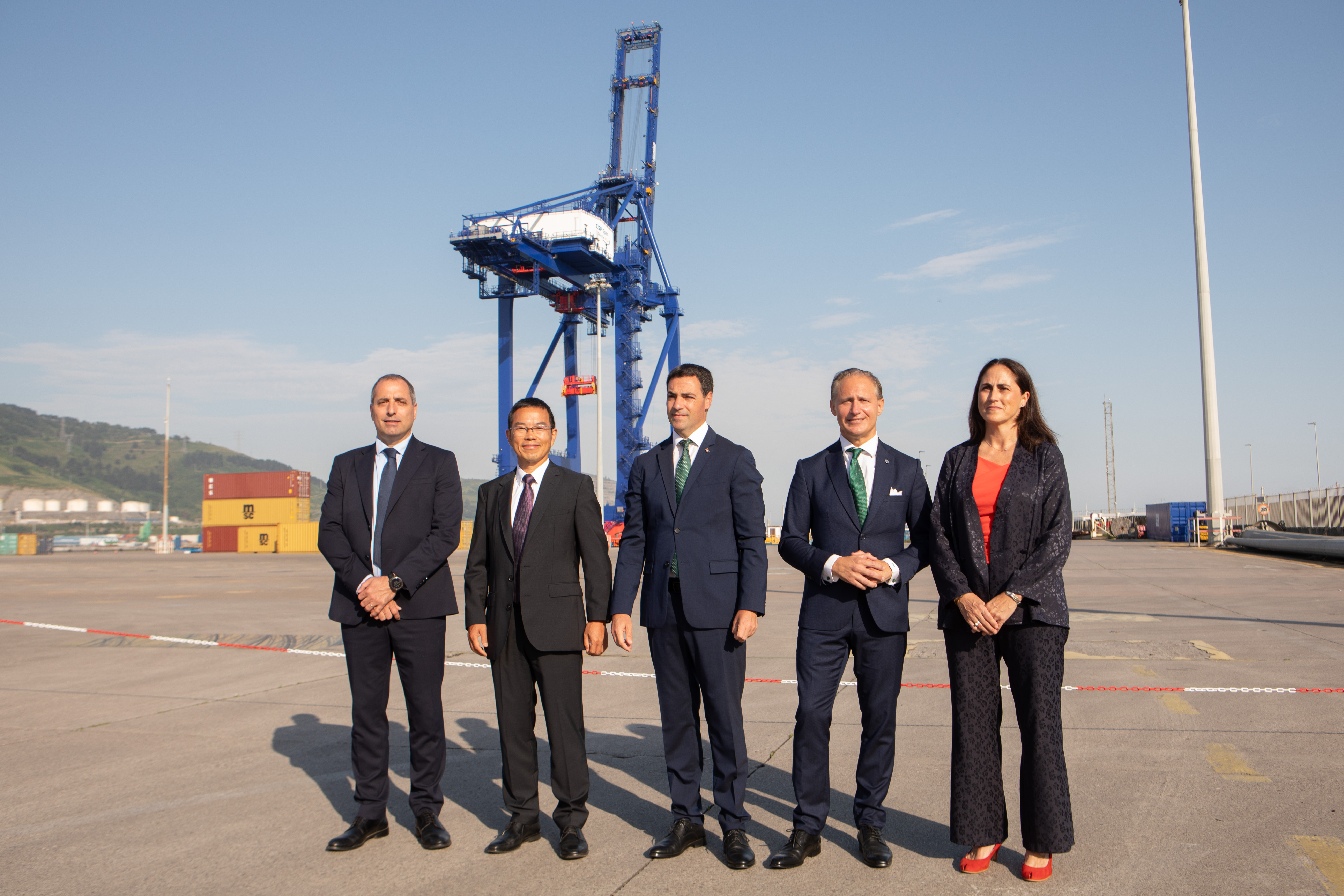
Elvira Gallego, general manager of CSP Iberian Bilbao Terminal, emphasised that innovation and new technologies represent a major opportunity for the container traffic business, stressing that “we must embrace them if we are to ensure the sustainability of our sector. They not only enable us to make better use of all the resources at our disposal, such as the strategic location of the Port of Bilbao, but also consolidate our position as a real and competitive alternative to other European ports”.
Ivan Jimenez, president of the Bilbao Port Authority, highlighted that “the acquisition of this new crane further consolidates the position of the Port of Bilbao in a sector as strategic and economically significant as container traffic. It enables us to make the most of our natural draught of 21 metres for container ships, to accommodate larger vessels, and, in turn, it increases our options regarding the hub services operated by the major shipping lines”. Jimenez pointed out that, unlike other European ports, Bilbao is not congested, which presents a great opportunity to attract new traffic, to open up to other markets and to capture goods that are currently transported by road to northern Europe. “In December last year, and thanks to a joint effort, we launched two new routes in partnership with the shipping company MSC: one to Canada, and the other to the west coast of South America. This new infrastructure will now bring us new opportunities that we intend to take full advantage of,” he commented.
During his speech, the Basque Premier highlighted the strategic role of ports as key infrastructure for the country’s economic growth and international standing. In this respect, he pointed out that “their importance will be even greater in a global landscape marked by uncertainty and geopolitical shifts”. He also praised the work being done by the Bilbao Port Authority “to strengthen the port’s position through initiatives linked to electrification, digital transformation and the opening up of new markets”.
CSP Iberian Bilbao Terminal: intermodality and connection with Europe
CSP Iberian Bilbao Terminal is part of the COSCO SHIPPING Ports (Spain) Terminals group. Strategically located in northern Spain, it serves as a key link in the connection between southern Europe and the main ports in the north of the continent. This new acquisition strengthens its operational capacity, consolidating its position as the leading terminal for container traffic in the Atlantic Arc, with unbeatable, efficient rail and road connections that enable trade across the Iberian Peninsula and south-western France.
In 2025, the Port of Bilbao handled around 4.8 million tonnes of containerised cargo and around 424,000 TEUs (twenty-foot equivalent units, a standard unit used in international trade: one TEU is equivalent to a 20-foot container, i.e. approximately six metres, so a 40-foot container is equivalent to two TEUs).
About CSP Spain and the CSPL Group
CSP Spain is part of CSPL, one of the largest port groups with a leading global presence. This business group operates more than 46 container terminals worldwide, handling a total of over 90 million TEUs.
CSP Spain’s commitment to technology and sustainability has been constant since its arrival in Spain in 1973, and this new STS crane is yet another example of its forward-looking vision. With this addition, CSP Iberian Bilbao Terminal reaffirms its commitment to operational efficiency, environmental protection and its role as a strategic partner to the logistics community in Bilbao and the wider European port sector.